
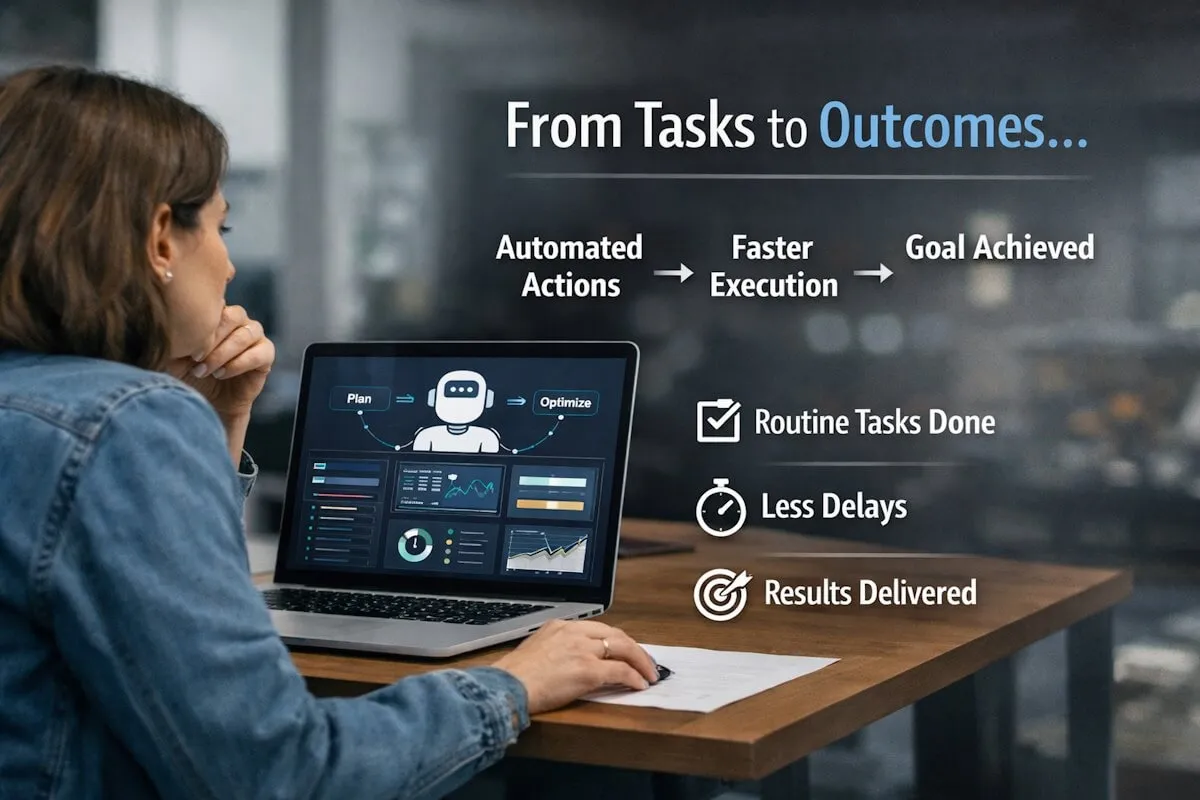
Execution used to be the hard part.
Ideas are easy. Strategies look great on slides. Plans get approved in meetings. But when it comes to actually getting things done, that’s where most businesses slow down.
Tasks pile up. Teams get stretched. Follow-ups slip. And suddenly, timelines start drifting.
Now something is shifting.
Agentic AI is changing how execution works at a very basic level. Not by making teams work harder, but by changing who or what is actually doing the work.
Let’s break it down.
From planning to doing, without the gap
Most businesses struggle with the gap between planning and execution.
You define a goal. Then you assign tasks. Then people start working through them. Somewhere along the way, delays happen.
Agentic systems reduce that gap.
Instead of turning goals into long task lists, these systems:
- Understand the objective
- Break it into steps
- Execute those steps
- Adjust when things change
You’re not just planning anymore. You’re setting things in motion.
And once it starts, it keeps moving.
Why execution has always been a bottleneck
Let’s be honest. Execution depends on people.
That’s not a bad thing. But it comes with limits.
People get busy. Priorities shift. Communication breaks down. Small tasks get missed.
Even with good teams, things don’t always run smoothly.
That’s where most delays come from.
Agentic AI doesn’t replace people. It removes the friction around them.
Routine execution doesn’t have to depend on constant human input anymore.
The move from task management to outcome management
This is a subtle shift, but it matters.
Earlier, businesses focused on managing tasks.
Who’s doing what? What’s the deadline? Has it been completed?
Now, the focus is shifting to outcomes.
With agentic systems, you define:
- What needs to be achieved
- What success looks like
And the system handles the steps in between.
You’re not tracking every small action. You’re tracking results.
That alone changes how teams operate.
Real-world execution looks different now
Let’s make this practical.
Marketing execution
Instead of manually managing campaigns, an agentic system can:
- Identify target audiences
- Create content variations
- Launch campaigns
- Monitor performance
- Adjust based on results
You’re still in control. But you’re not doing every step.
Sales execution
Follow-ups are often where deals are won or lost.
An agentic system can:
- Track interactions
- Schedule follow-ups
- Send messages at the right time
- Adjust based on customer behavior
No more missed opportunities because someone forgot to reply.
Operations and workflows
Internal processes are full of repetitive tasks.
Agentic systems can:
- Assign tasks automatically
- Track progress
- Resolve minor issues
- Escalate only when needed
Things keep moving without constant supervision.
Speed changes everything
Execution speed is not just about working faster.
It’s about reducing delays between steps.
In traditional setups:
- Task completed
- Waiting for review
- Waiting for next action
- Waiting for approval
These gaps add up.
Agentic systems reduce these waiting periods.
Actions happen in sequence, without unnecessary pauses.
That creates momentum.
And momentum is hard to compete with.
Consistency without constant oversight
Another challenge in execution is consistency.
Different people approach tasks differently. That leads to variation.
Sometimes that’s good. Sometimes it creates problems.
Agentic systems follow defined logic.
That means:
- Tasks are handled the same way every time
- Processes stay consistent
- Errors are reduced
You don’t have to keep checking if things are being done right.
They just are.
The role of humans doesn’t disappear
Let’s clear something up.
This shift doesn’t make teams irrelevant.
It changes what they focus on.
Instead of spending time on repetitive execution, teams can:
- Think strategically
- Solve complex problems
- Improve processes
- Build relationships
The work becomes more meaningful.
And honestly, more valuable.
Why many businesses are still hesitant
Even with all these benefits, adoption is slow in some cases.
Why?
Because execution is core to business operations.
Any change feels risky.
There’s also a lack of clarity around where to start.
Some businesses try to automate everything at once. That creates confusion.
Others wait too long and fall behind.
A better way to approach this shift
You don’t need a full overhaul.
Start with one area.
Look for processes that are:
- Repetitive
- Time-consuming
- Prone to delays
Test agentic systems there.
Learn from it. Adjust. Then expand.
Working with providers offering Agentic AI Development Services can help you identify the right starting points and build systems that actually fit your workflows.
That saves time and avoids unnecessary trial and error.
Why execution design matters more than ever
Here’s something that doesn’t get enough attention.
Agentic systems are only as good as their design.
If goals are unclear, the system won’t perform well.
If workflows are messy, execution becomes unreliable.
That’s why it’s important to get the structure right from the start.
When you Hire AI Agent Developers, you’re bringing in people who know how to:
- Define clear execution paths
- Build reliable action flows
- Handle unexpected scenarios
That foundation makes all the difference.
Industries already seeing the impact
This shift is not limited to one sector.
E-commerce
Order processing, customer communication, inventory updates. All moving with less manual effort.
SaaS
User onboarding, support flows, and feature adoption can be handled more smoothly.
Finance
Routine checks, reporting, and monitoring can run continuously without delays.
Healthcare
Scheduling, reminders, and basic coordination tasks become easier to manage.
Any business with repeatable execution can benefit.
What this means for the next few years
Execution will no longer be the limiting factor.
Ideas will move faster. Decisions will turn into actions quicker.
Businesses that adopt agentic systems early will:
- Operate with fewer delays
- Handle more work without scaling teams
- Respond faster to market changes
Others will still rely on manual coordination.
That gap will grow over time.
Where do you start?
Keep it simple.
Ask yourself:
- What slows your team down the most?
- Where do tasks get stuck?
- What requires constant follow-up?
These are your entry points.
You don’t need to solve everything at once.
Just start.
The bigger picture
Execution used to depend on constant effort.
Now it can run continuously in the background.
That’s a big change.
It doesn’t mean less control. It means less friction.
And when friction goes down, everything else speeds up.
So, what’s your next move?
You can keep managing execution the traditional way.
Or you can start shifting toward systems that handle it for you.
The choice is not just about technology.
It’s about how you want your business to operate in the coming years.
Because one thing is clear.
Execution is no longer just about getting things done.
It’s about how efficiently, consistently, and independently those things happen.